






.
First, I found that a favourite Spanish blogger is still active and has moved here, and second, that he has done his sums and that not only is a Consistory due, but that another is due next year.
Four Cardinals will lose their right to vote in the next couple of months; that will leave twelve vacancies in the Sacred College; seven more will lose their right to vote by the end of the year. And next year six will go before Easter. This should mean a Consistory this year, and another at the back end of next year.
Only three Cardinals will have to present their resignation this year from their episcopal sees, but next year another eleven will be off. This will mean the possibility of starting the great process of change in places like Los Angeles, even if there are five more years before Cardinal mahony loses his voting rights in the Conclave.
Imagine what opportunity this gives to the Holy Father to shape the Church for the reform of the reform! And imagine the insignificance of the Hierarchy of England and Wales, faced with this catclysmic set of opportunities.
Details available in Spanish here.
26 January 2010


25 January 2010
The Suppository
.
I got hold of a copy of last week's Tablet to see if I could work out how it turns a profit: I couldn't.
It suffers from the same problem as all other serious weeklies as the world moves to rolling news: it has nothing original to say about the news that wasn't said within 24 hours of whatever happened happening. And as its USP is left wing, there aren't many people around who are prepared to read ten days late what Peter really said to Gordon.
So the only area in which it has anything original to say is about religion, and Gosh! it's tedious. It is relentlessly on message where the message is a particularly English interpretation of the Spirit of Vatican II. If it met Wir Sind Kirche, both sides would need interpreters, ambassadors, intermediaries: because if you don't understand the UK of NuLabour, you won't understand the Catholic Church of the Tabletistas.
I even read the tendentious, lying, drivel written by Fr Michael G Ryan about the new translation of the Mass to see if it was as bad as everybody said it was: it wasn't really. It was just banal, tendentious, lying, drivel.
I had wondered if we were subsidising the rag by our parishes' overbuying vast quantities of it, but according to Valle Adurni here, everything comes on sale or return.
So we have to face up to the fact that some way or another, enough people are prepared to shell out money to allow the Suppository to turn sufficient profit to allow it to fund scholarships in Spirit of Vatican II liturgical activity (I kid you not).
"The enemy at last was plain in view, huge and hateful, all disguise cast off. It was the Modern Age in arms."
It is rich too.
.
I got hold of a copy of last week's Tablet to see if I could work out how it turns a profit: I couldn't.
It suffers from the same problem as all other serious weeklies as the world moves to rolling news: it has nothing original to say about the news that wasn't said within 24 hours of whatever happened happening. And as its USP is left wing, there aren't many people around who are prepared to read ten days late what Peter really said to Gordon.
So the only area in which it has anything original to say is about religion, and Gosh! it's tedious. It is relentlessly on message where the message is a particularly English interpretation of the Spirit of Vatican II. If it met Wir Sind Kirche, both sides would need interpreters, ambassadors, intermediaries: because if you don't understand the UK of NuLabour, you won't understand the Catholic Church of the Tabletistas.
I even read the tendentious, lying, drivel written by Fr Michael G Ryan about the new translation of the Mass to see if it was as bad as everybody said it was: it wasn't really. It was just banal, tendentious, lying, drivel.
I had wondered if we were subsidising the rag by our parishes' overbuying vast quantities of it, but according to Valle Adurni here, everything comes on sale or return.
So we have to face up to the fact that some way or another, enough people are prepared to shell out money to allow the Suppository to turn sufficient profit to allow it to fund scholarships in Spirit of Vatican II liturgical activity (I kid you not).
"The enemy at last was plain in view, huge and hateful, all disguise cast off. It was the Modern Age in arms."
It is rich too.
.
17 January 2010
16 January 2010
Stand Up 2 Stand Up 4 Vatican 2
.
Text talk, eh? How kewl and down with the kids was it to write "4" and "2" instead of "for" and "two" (or "II")? Anyway, although this mob is being done to death, two commentsfrom me that I haven't seen elsewhere: money and age.
The first meeting was originally going to take place in property belonging to the Church (St Vincent's, Carlisle Place), but has now moved to a suite in the Westminster Thistle Hotel. That will cost money: so who's paying? Are the CAFOD adverts generating that much money?
Why can they find nobody under seventy to speak at their meeting? Michael Winter is a 79 year old who preferred marriage to the priesthood; Myra Poole has been a Notre Dame de Naumur sister for over 50 years; she said "I have always said in my life I gained more understanding of the real Gospel when Ken Livingstone was in charge of the former London authority in the 70s and the 80s than from any church". The Chair of the meeting, Frank Regan, is, I assume, the former Columban Father whose belief in Liberation Theology led him to be a trade union activist in South America before he married and retired to Devon, though he is still called on by Catholic Dioces like Clifton to run Justice and Peace, and Ecology shindigs (see here and here (the latter "here" is a link to that rarest of thing, a drippingly progressive "Spirit of Vatican II" blog)).
The final speaker, the assistant editor of The Suppository, Robert Nowell, is "merely" a translator of Hans Kung. In the company of the others, he probably passes for a Trad!
This being an open meeting, anybody who can spend two hours of a Tuesday evening in Central London can attend. The problem is that we are too polite: this meeting should be packed with people who are prepared to protest loudly, not just every time that a heterodox or heretical opinion is uttered, but every time the message of Vatican II is traduced.
But it's probably only old age pensioners who don't have to work the next day who will be able to attend.
Text talk, eh? How kewl and down with the kids was it to write "4" and "2" instead of "for" and "two" (or "II")? Anyway, although this mob is being done to death, two commentsfrom me that I haven't seen elsewhere: money and age.
The first meeting was originally going to take place in property belonging to the Church (St Vincent's, Carlisle Place), but has now moved to a suite in the Westminster Thistle Hotel. That will cost money: so who's paying? Are the CAFOD adverts generating that much money?
Why can they find nobody under seventy to speak at their meeting? Michael Winter is a 79 year old who preferred marriage to the priesthood; Myra Poole has been a Notre Dame de Naumur sister for over 50 years; she said "I have always said in my life I gained more understanding of the real Gospel when Ken Livingstone was in charge of the former London authority in the 70s and the 80s than from any church". The Chair of the meeting, Frank Regan, is, I assume, the former Columban Father whose belief in Liberation Theology led him to be a trade union activist in South America before he married and retired to Devon, though he is still called on by Catholic Dioces like Clifton to run Justice and Peace, and Ecology shindigs (see here and here (the latter "here" is a link to that rarest of thing, a drippingly progressive "Spirit of Vatican II" blog)).
The final speaker, the assistant editor of The Suppository, Robert Nowell, is "merely" a translator of Hans Kung. In the company of the others, he probably passes for a Trad!
This being an open meeting, anybody who can spend two hours of a Tuesday evening in Central London can attend. The problem is that we are too polite: this meeting should be packed with people who are prepared to protest loudly, not just every time that a heterodox or heretical opinion is uttered, but every time the message of Vatican II is traduced.
But it's probably only old age pensioners who don't have to work the next day who will be able to attend.
14 January 2010

13 January 2010
Usus Antiquior
.


One advantage of being off work is being at home when the postman comes. All the more so today, when the satisfying thud on the doormat heralded the arrival of the first number of Usus Antiquior.
Obviously I can't pass any comment yet other than to say three things:
It looks good: noble simplicity and all that.
Just the contents tell you that this a serious journal: it is not a trad Tablet.
And the footnotes are footnotes, and not endnotes, normally the bane of the life of the reader of academic journals.
See you whenever!
11 January 2010
Stamp For Pope's Visit
.
 What do you think of this as the stamp for this year's visit to the UK by the Pope?
 What do you think of this as the stamp for this year's visit to the UK by the Pope?
 It's available now, in a sheet at £13.83 for 20.
Guess what? I made it myself.
Go to the Royal Mail's website and look for "Smilers".
Anybody can make any stamp they like.
We could have a lot of fun AND annoy Richard Dawkins and Polly Toynbee. What are we waiting for?
The Anglican Patrimony
.
I was thinking about what parts of the Anglican Patrimony I'd like those who become part of the Ordinariates to bring with them, and which not and decided in the end to make it a bit meme-like.
Which single item of the Anglican Patrimony would you like to see Anglicans bring with them, and which single item would you like them to leave behind?
My positive would be public praying of the breviary, or at least of Mattins and Evensong. I've never attended (Catholic) sung Vespers in my life nor lived anywhere where it was a feature.
The bit I hope they leave behind is synodal government. Bossy middle class people will always dominate any elected body from Parliament to a school's Governing Body, and they will always believe that being elected gives them the right to impose their bossy middle class opinions - hence the C of E! (Not to say that the Catholic Church in E&W isn't heading inexorably in that direction.)
Does anybody else want to play? (You can't say things like "reverent liturgy", because we should have those anyway.)
I was thinking about what parts of the Anglican Patrimony I'd like those who become part of the Ordinariates to bring with them, and which not and decided in the end to make it a bit meme-like.
Which single item of the Anglican Patrimony would you like to see Anglicans bring with them, and which single item would you like them to leave behind?
My positive would be public praying of the breviary, or at least of Mattins and Evensong. I've never attended (Catholic) sung Vespers in my life nor lived anywhere where it was a feature.
The bit I hope they leave behind is synodal government. Bossy middle class people will always dominate any elected body from Parliament to a school's Governing Body, and they will always believe that being elected gives them the right to impose their bossy middle class opinions - hence the C of E! (Not to say that the Catholic Church in E&W isn't heading inexorably in that direction.)
Does anybody else want to play? (You can't say things like "reverent liturgy", because we should have those anyway.)
07 January 2010
Not Quite Fr Z's Display But ...
 The birds sit hunched in the tree against the snow.
The thrush looks miserable.
 The robin wants me to go.
The sparrows don't care.
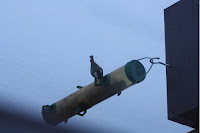
A solitary marsh tit condescends to visit the feeder.


A solitary marsh tit condescends to visit the feeder.

A finch looks for shelter.


The blackbird takes some bread to eat in peace.

And the thrush eventually makes its way to the bird table.

And the thrush eventually makes its way to the bird table.
The jays, barn owl, magpies, ravens and something I might have sworn was a redwing refused to be photographed.
Musings About Priesthood
.
It was HJMW, here, who articulated better than I had that I was disturbed by what I might describe as a leaning towards liturgiolatry: a devotion to the performance of the Liturgy rather than the veneration of the Liturgy as an eikon of Christ's sacrifice. An MC reminding a server in private after Mass about the order in which to light and put out the candles on the altar is a good example of the latter; two middle-aged men complaining that it isn't being done properly five minutes before Mass starts could be an example of the former.
My musings have taken me off in another direction, however: why does Newchurch so eschew the term "priest" to describe the man at the center of the liturgical action? Minister, Celebrant, President, Pastor - why not Priest?
I speculate that the reason is not that the NO Mass was to become as like a Protestant service as possible, as some always try to argue, but that the notion of "priest" was foreign to the minds of the reformers, who considered it a relic of mediaevalism.
The Priest at Mass doesn't just re-present Christ's sacrifice: he stands in the line of priests who stretch back through the Old Testament and whose job was to offer sacrifice by slaughtering animals on God's Altar. Even if Christ's Sacrifice is once and for all, and the activity of the priest no longer encompasses such sacrifices, it nevertheless remains the fact that sacrifice is what priests do.
It is hard to think of the way in which sacrificial priesthood is being made manifest by the President of a communal meal. And while I am sure that most priests still believe in the Real Presence, if they do not have an adequate conception of priesthood and sacrifice, then their belief about the change in the species effected by the words of consecration turns them into magicians: the Eucharistic Prayer becomes one long "Abracadabra", and the opening greeting ought to be "You'll like this". And all of a sudden it's no longer difficult to imagine: that priests have no need to be set apart; that their nature is unchanged by their ordination; that celibacy is irrelevant to their condition; that they should necessarily be masculine; for their function has changed. They are no longer sacrificial priests.
"Save the Liturgy, Save the World"; "Do the Red, Say the Black"; are, I'm afraid, inadequate as rallying cries.
"Priests: Be Priests!"
It was HJMW, here, who articulated better than I had that I was disturbed by what I might describe as a leaning towards liturgiolatry: a devotion to the performance of the Liturgy rather than the veneration of the Liturgy as an eikon of Christ's sacrifice. An MC reminding a server in private after Mass about the order in which to light and put out the candles on the altar is a good example of the latter; two middle-aged men complaining that it isn't being done properly five minutes before Mass starts could be an example of the former.
My musings have taken me off in another direction, however: why does Newchurch so eschew the term "priest" to describe the man at the center of the liturgical action? Minister, Celebrant, President, Pastor - why not Priest?
I speculate that the reason is not that the NO Mass was to become as like a Protestant service as possible, as some always try to argue, but that the notion of "priest" was foreign to the minds of the reformers, who considered it a relic of mediaevalism.
The Priest at Mass doesn't just re-present Christ's sacrifice: he stands in the line of priests who stretch back through the Old Testament and whose job was to offer sacrifice by slaughtering animals on God's Altar. Even if Christ's Sacrifice is once and for all, and the activity of the priest no longer encompasses such sacrifices, it nevertheless remains the fact that sacrifice is what priests do.
It is hard to think of the way in which sacrificial priesthood is being made manifest by the President of a communal meal. And while I am sure that most priests still believe in the Real Presence, if they do not have an adequate conception of priesthood and sacrifice, then their belief about the change in the species effected by the words of consecration turns them into magicians: the Eucharistic Prayer becomes one long "Abracadabra", and the opening greeting ought to be "You'll like this". And all of a sudden it's no longer difficult to imagine: that priests have no need to be set apart; that their nature is unchanged by their ordination; that celibacy is irrelevant to their condition; that they should necessarily be masculine; for their function has changed. They are no longer sacrificial priests.
"Save the Liturgy, Save the World"; "Do the Red, Say the Black"; are, I'm afraid, inadequate as rallying cries.
"Priests: Be Priests!"
04 January 2010
So What Are Our Bishops For?
You could look up the Catechism of the Catholic Church here, but why bother, since our own Bishops tell us what they are for in the annual statement of their accounts, here.
"The Catholic Bishops' Conference of England and Wales is a permanent body within the organisation of the Catholic Church that brings together the Bishops of England and Wales. As a Conference the Bishops "jointly exercise certain pastoral functions for the Christian faithful... in order to promote the greater good which the Church offers to humanity, especially through forms and programs of the apostolate fittingly adapted to the circumstances of time and place".
So note, from the word go, that certain pastoral functions of the Bishops are exercised jointly: sovereignty has been pooled, so that forms and programmes of the apostolate fittingly adapted to the circumstances of England and Wales at the beginning of the 21st Century may be carried out.
“All the Bishops of England and Wales meet together twice a year to decide policies for the Church at a national level. These week-long gatherings occur soon after Easter (Low Week) and in November. Each bishop chairs a committee of experts dealing with a specific area of concern for the Church. Committees are grouped into departments for practical purposes. ”
Accommodation and other costs for Bishops’ Conference Meetings in 2008: £236,975 (about £15,000 per diocese!)
International Affairs
The Department Bishops continued work on their five main priorities: migration and asylum; the global common good, European issues, the environment and religious freedom. These themes have been identified by the bishops as priorities after a careful analysis of needs and resources. Progress continued in all these areas throughout the year. Some example include the work of the Holy Land Coordination which gathered in Jerusalem and the West Bank for its annual meetings.
This year the Bishops also met in Rome with Secretary of State Cardinal Bertone as well as Cardinal Sandri and Archbishop Mamberti to endorse the coordination and to discuss its strategy. The Friends of the Holy Land (FHL), a partnership between the Department and the Knights of the Holy Sepulchre underwent successful trials in two dioceses and will be launched in 2009. The FHL will enable the Department to incream its support for the Local Church and to raise awareness about the challenges it faces.
The Department document The Mission of the Church to Migrants in England and Wales was published in 2008. This represented the culmination of a process of pastoral reflection and consultation and will provide the framework for the Department's future work in this area.
Liaison with the European Bishops' conferences continued, mainly through the work of COMECE in Brussels and CCEE in St Gallen. One successful outcome was the hosting in Liverpool of the SECAM-CCEE meeting of European and African bishops. The Department also continued to work with the Zimbabwean Church. Cardinal Murphy-O'Connor and Bishop Hollis visited Harare in January and then welcomed Archbishop Ndlovu and Bishop Munyani as guests when they came to London and Leeds in the autumn.
The objectives for 2009 include the national launch of the Friends of the Holy Land and increasing the Department's collaboration with Caritas Social Action on migration and asylum.
Cost of International Affairs in 2008: £188,074
Ecumenism isn’t cheap. The subscription to Churches Together cost £117,767; to CBTI Interfaith £3,737; to CTBI Racial Justice £7,913; to Churches Commission on Mission £22,941; and to Churches Commission for International Students £392.
And how much has it cost you? Well, it depends on your Diocese:
Arundel and Brighton £91,447
Birmingham £141,169
Brentwood £91,100
Cardiff £35,813
Clifton £58,415
East Anglia £31,816
Hallam £22,254
Hexham and Newcastle £108,659
Lancaster £43,985
Leeds £81,712
Liverpool £124,827
Menevia £348
Middlesbrough £31,294
Northampton £55,112
Nottingham £69,715
Plymouth £38,075
Portsmouth £86,580
Salford £122,220
Shrewsbury £85,536
Southwark £151,596
Westminster £263,390
Wrexham £3,477
Bishopric of the Forces £4,500
Total £1,743,040
Now, apart from a quick shout of Floreat Menevia!, what comes next?
Remember, that each one of those pounds comes from a pound that went into the collection plate in your parish. Find out how much of your parish's collection goes ditrect to the diocese: its 45% in mine. Then ask what proportion of the diocesan income is represented by the totals above, and ask why that much of your local Church's money is compulsorily levied to go on things such as those listed above. (There are lots of other things the Bishops' Conference does too.)
Point out to your Parish Priest that if this is where your money is going, then you will take steps to ensure that it heads elsewhere. Three quarters of your normal offering to him to be split between a Mass stipend, and repairs to the Church fabric (especially if there is a building fund) will ensure that the Parish doesn't suffer. The other quarter to the Catholic charity of your choice ensures that the extra-parochial aspect of your giving is taken care of.
Is there a problem with this?
"The Catholic Bishops' Conference of England and Wales is a permanent body within the organisation of the Catholic Church that brings together the Bishops of England and Wales. As a Conference the Bishops "jointly exercise certain pastoral functions for the Christian faithful... in order to promote the greater good which the Church offers to humanity, especially through forms and programs of the apostolate fittingly adapted to the circumstances of time and place".
So note, from the word go, that certain pastoral functions of the Bishops are exercised jointly: sovereignty has been pooled, so that forms and programmes of the apostolate fittingly adapted to the circumstances of England and Wales at the beginning of the 21st Century may be carried out.
“All the Bishops of England and Wales meet together twice a year to decide policies for the Church at a national level. These week-long gatherings occur soon after Easter (Low Week) and in November. Each bishop chairs a committee of experts dealing with a specific area of concern for the Church. Committees are grouped into departments for practical purposes. ”
Accommodation and other costs for Bishops’ Conference Meetings in 2008: £236,975 (about £15,000 per diocese!)
International Affairs
The Department Bishops continued work on their five main priorities: migration and asylum; the global common good, European issues, the environment and religious freedom. These themes have been identified by the bishops as priorities after a careful analysis of needs and resources. Progress continued in all these areas throughout the year. Some example include the work of the Holy Land Coordination which gathered in Jerusalem and the West Bank for its annual meetings.
This year the Bishops also met in Rome with Secretary of State Cardinal Bertone as well as Cardinal Sandri and Archbishop Mamberti to endorse the coordination and to discuss its strategy. The Friends of the Holy Land (FHL), a partnership between the Department and the Knights of the Holy Sepulchre underwent successful trials in two dioceses and will be launched in 2009. The FHL will enable the Department to incream its support for the Local Church and to raise awareness about the challenges it faces.
The Department document The Mission of the Church to Migrants in England and Wales was published in 2008. This represented the culmination of a process of pastoral reflection and consultation and will provide the framework for the Department's future work in this area.
Liaison with the European Bishops' conferences continued, mainly through the work of COMECE in Brussels and CCEE in St Gallen. One successful outcome was the hosting in Liverpool of the SECAM-CCEE meeting of European and African bishops. The Department also continued to work with the Zimbabwean Church. Cardinal Murphy-O'Connor and Bishop Hollis visited Harare in January and then welcomed Archbishop Ndlovu and Bishop Munyani as guests when they came to London and Leeds in the autumn.
The objectives for 2009 include the national launch of the Friends of the Holy Land and increasing the Department's collaboration with Caritas Social Action on migration and asylum.
Cost of International Affairs in 2008: £188,074
Ecumenism isn’t cheap. The subscription to Churches Together cost £117,767; to CBTI Interfaith £3,737; to CTBI Racial Justice £7,913; to Churches Commission on Mission £22,941; and to Churches Commission for International Students £392.
And how much has it cost you? Well, it depends on your Diocese:
Arundel and Brighton £91,447
Birmingham £141,169
Brentwood £91,100
Cardiff £35,813
Clifton £58,415
East Anglia £31,816
Hallam £22,254
Hexham and Newcastle £108,659
Lancaster £43,985
Leeds £81,712
Liverpool £124,827
Menevia £348
Middlesbrough £31,294
Northampton £55,112
Nottingham £69,715
Plymouth £38,075
Portsmouth £86,580
Salford £122,220
Shrewsbury £85,536
Southwark £151,596
Westminster £263,390
Wrexham £3,477
Bishopric of the Forces £4,500
Total £1,743,040
Now, apart from a quick shout of Floreat Menevia!, what comes next?
Remember, that each one of those pounds comes from a pound that went into the collection plate in your parish. Find out how much of your parish's collection goes ditrect to the diocese: its 45% in mine. Then ask what proportion of the diocesan income is represented by the totals above, and ask why that much of your local Church's money is compulsorily levied to go on things such as those listed above. (There are lots of other things the Bishops' Conference does too.)
Point out to your Parish Priest that if this is where your money is going, then you will take steps to ensure that it heads elsewhere. Three quarters of your normal offering to him to be split between a Mass stipend, and repairs to the Church fabric (especially if there is a building fund) will ensure that the Parish doesn't suffer. The other quarter to the Catholic charity of your choice ensures that the extra-parochial aspect of your giving is taken care of.
Is there a problem with this?
18 November 2009
A Hiatus
.
I'm not blogging again, at least until after Christmas. There are three main reasons:
First, I can rely on the blogosphere, or even the Internet for fellowship, but not for communion, and if I cannot find any way to articulate the manner in which I am in full and proper communion with either my parish priest or my Bishop, while each of them claims to be in communion with the Pope, I need to spend time looking for why somewhere other than here.
Second, I want to reflect on trad Catholic blogging from the outside: the LMS created a fortress of insularity because it needed to. I think that time has gone, but I sometimes sense a new insularity online, that seems to value an idea of ultratrad heteropraxis. "My praxy is better than your praxy" is less bad than "my doxy is better than your doxy", but it isn't good.
(First and second leave me wondering what exactly the Catholic blogosphere is: not national exactly, and not a comunion; not a movement, even if "New"; unguided, unshepherded, even if blessed with a really rich crop of posting pastors; what is the sense in which it is "Catholic" when it consists of lots of people expressing their own interpretation of things?)
Third, I'm not convinced that I'm keeping up with the Zeitgeist: lot's of you are racing off while I feel quite happy at rest. The fact that I can go to EF Mass every week if I try, and so can lots of others, while we can also go to OF Mass every day, feels like a decent start, and one worth bedding in, especially if the alternative involves lots of arguing. I have some big things to argue about with my spiritual betters, but the availability of the Holy Sacrifice of the Mass isn't one of them.
I'll still haunt you: I'll comment when I feel moved to. But a pause for reflection might throw up an idea about whether I have anything unquerulous to say, and about how to say it.
God Bless you all, and be assured of my daily prayers.
.
I'm not blogging again, at least until after Christmas. There are three main reasons:
First, I can rely on the blogosphere, or even the Internet for fellowship, but not for communion, and if I cannot find any way to articulate the manner in which I am in full and proper communion with either my parish priest or my Bishop, while each of them claims to be in communion with the Pope, I need to spend time looking for why somewhere other than here.
Second, I want to reflect on trad Catholic blogging from the outside: the LMS created a fortress of insularity because it needed to. I think that time has gone, but I sometimes sense a new insularity online, that seems to value an idea of ultratrad heteropraxis. "My praxy is better than your praxy" is less bad than "my doxy is better than your doxy", but it isn't good.
(First and second leave me wondering what exactly the Catholic blogosphere is: not national exactly, and not a comunion; not a movement, even if "New"; unguided, unshepherded, even if blessed with a really rich crop of posting pastors; what is the sense in which it is "Catholic" when it consists of lots of people expressing their own interpretation of things?)
Third, I'm not convinced that I'm keeping up with the Zeitgeist: lot's of you are racing off while I feel quite happy at rest. The fact that I can go to EF Mass every week if I try, and so can lots of others, while we can also go to OF Mass every day, feels like a decent start, and one worth bedding in, especially if the alternative involves lots of arguing. I have some big things to argue about with my spiritual betters, but the availability of the Holy Sacrifice of the Mass isn't one of them.
I'll still haunt you: I'll comment when I feel moved to. But a pause for reflection might throw up an idea about whether I have anything unquerulous to say, and about how to say it.
God Bless you all, and be assured of my daily prayers.
.
10 November 2009
Prayers, Please, Times Three
.
Once, for the family of a dear friend and commenter who has just become a grandfather.
Secondly, for Fr Hunwicke, faced with a big choice.
Third, for a Catholic priest who, up to the limits with his Bishop, took the Anglican option to maintain, as he thought, his opportunity to be Catholic. A Motu Proprio and an Apostolic Constitution later, and he is in a very difficult position indeed, and needs lots and lots of prayers.
.
Once, for the family of a dear friend and commenter who has just become a grandfather.
Secondly, for Fr Hunwicke, faced with a big choice.
Third, for a Catholic priest who, up to the limits with his Bishop, took the Anglican option to maintain, as he thought, his opportunity to be Catholic. A Motu Proprio and an Apostolic Constitution later, and he is in a very difficult position indeed, and needs lots and lots of prayers.
.
08 November 2009
Iconoclasm
.
Over in the valley of the River Adur, Fr Sean posted something really good about the manner in which those attached to more traditional forms of Catholic worship should celebrate. He didn't say that 1962 Missal is perfection, just that messing about with the rubrics at this time would be a really unsensible thing to do. I agree wholeheartedly with him.
The best way, perhaps, to think of what happened in the Roman Church after Vatican II and until the election of the current Pope, is to compare it with the iconoclasm which shook the East in the eighth and ninth centuries, not least because one of the arguments the iconoclasts used was that only in the Divine Liturgy itself could Christ Himself be truly seen, and Mass itself, and the manner in which it is celebrated is an icon.
Our iconoclasts have not given up: they are bent on maintaining their austere vision of a communal gathering in a whitewashed hall and will fight for it. They are tremedously powerful, and are cornered, so their victory over a disunited opponent is almost assured: their victory over a united opponent is much less so.
Let's not tryto unpick the reforms of Pius X or Pius XII just yet: let's concentrate on placing 1962 in opposition to "the spirit of Vatican II", and defeating that. Let's behave like Catholics and think in centuries: few of those of us alive today will see the way the Church rights herself after such a turbulent century as the twentieth, so let's not try to bring the Millennium about by ourselves. And let's make sure that we don't make of ourselves a focus for disunity by deciding that the rubrics are for others, and not for us.
Over in the valley of the River Adur, Fr Sean posted something really good about the manner in which those attached to more traditional forms of Catholic worship should celebrate. He didn't say that 1962 Missal is perfection, just that messing about with the rubrics at this time would be a really unsensible thing to do. I agree wholeheartedly with him.
The best way, perhaps, to think of what happened in the Roman Church after Vatican II and until the election of the current Pope, is to compare it with the iconoclasm which shook the East in the eighth and ninth centuries, not least because one of the arguments the iconoclasts used was that only in the Divine Liturgy itself could Christ Himself be truly seen, and Mass itself, and the manner in which it is celebrated is an icon.
Our iconoclasts have not given up: they are bent on maintaining their austere vision of a communal gathering in a whitewashed hall and will fight for it. They are tremedously powerful, and are cornered, so their victory over a disunited opponent is almost assured: their victory over a united opponent is much less so.
Let's not tryto unpick the reforms of Pius X or Pius XII just yet: let's concentrate on placing 1962 in opposition to "the spirit of Vatican II", and defeating that. Let's behave like Catholics and think in centuries: few of those of us alive today will see the way the Church rights herself after such a turbulent century as the twentieth, so let's not try to bring the Millennium about by ourselves. And let's make sure that we don't make of ourselves a focus for disunity by deciding that the rubrics are for others, and not for us.
07 November 2009
Something Latvian For the Weekend
.
Some years ago, I was in Mons in Belgium representing my country and had left an interminable reception to go outside for a smoke. I met a Latvian colleague there and told him that I remembered hearing a beautiful Latvian song once years before, and that the tune had never left me, and sang it for him. "You mean 'Saule Perkons Daugava'" he said, and fished out a CD from his pocket and gave it me there and then. It is one of the most evocative pieces of music I know, and sung here by 10,000 people, it sounds good (though I will confess I prefer the non-electric version I have on disc).
Some years ago, I was in Mons in Belgium representing my country and had left an interminable reception to go outside for a smoke. I met a Latvian colleague there and told him that I remembered hearing a beautiful Latvian song once years before, and that the tune had never left me, and sang it for him. "You mean 'Saule Perkons Daugava'" he said, and fished out a CD from his pocket and gave it me there and then. It is one of the most evocative pieces of music I know, and sung here by 10,000 people, it sounds good (though I will confess I prefer the non-electric version I have on disc).
03 November 2009
Fr Hugh Thwaites
.
I had been looking for some new mp3s to listen to on the bus and went to the Pro Ecclesia et Pontifice website to see if they had anything. Nothing much inspired me, but I was sufficiently intrigued by the following quote to download a couple of talks:
War Memoirs of an Amateur by Rev. Hugh Thwaites SJ
"In that first letter home I told my parents I had become a Catholic since leaving England, and that, in spite of everything (42 months in Changi gaol) I'd had the happiest three and a half years of my life".
The first talk was better recorded than the second, but, that apart, this is an experience separate to any I have ever had. I have heard many stories of captivity by the Japanese, but none before that have been inspired by Christian Joy. This story has been a life-changing experience for me. I have never so wanted a story not to end since childhood.
.
I had been looking for some new mp3s to listen to on the bus and went to the Pro Ecclesia et Pontifice website to see if they had anything. Nothing much inspired me, but I was sufficiently intrigued by the following quote to download a couple of talks:
War Memoirs of an Amateur by Rev. Hugh Thwaites SJ
"In that first letter home I told my parents I had become a Catholic since leaving England, and that, in spite of everything (42 months in Changi gaol) I'd had the happiest three and a half years of my life".
The first talk was better recorded than the second, but, that apart, this is an experience separate to any I have ever had. I have heard many stories of captivity by the Japanese, but none before that have been inspired by Christian Joy. This story has been a life-changing experience for me. I have never so wanted a story not to end since childhood.
.
01 November 2009
The Future In Clifton ...
.
I posted a few days ago about the forthcoming reorganisation of the parishes of the diocese of Clifton: the draft report is here.
What irks me (well, one of the things that irks me) is the assumption that the decline in vocations to the priesthood in their diocese is inevitable. Their "best case scenario" assumes that the number of priests will decline by 30% in the next fifteen years (the ridiculously implausible worst case shows a 75% decline, the "median case" - the management-speak is all-pervasive - shows a 40% decline). Do a search on the word "vocation" however, and nothing is found.
If you pentrate the opaque language, however, then some of what this is all about becomes clearer:
"Part of our preparation for the future was the diocesan-wide consultation process “Seeking the Face of Christ” during which a very strong sense emerged that, though we recognise an incredible richness in our past and present, there are aspects of how we operate as a diocese, especially with regard to how we are organised for evangelisation and pastoral care, that need to be reconsidered. This need to reconsider our structures was taken into account in our Diocesan Guidelines “Called to be a People of Hope”, where, tellingly, it has been included in the section ‘Church as Communion’. We are reminded that:
“The root of our understanding of Church as Communion is not ensuring efficient management but understanding what sort of Church God is calling us to be. Pope John Paul II in his letter to mark the beginning of the new millennium reminded us that when the structures of the Church reflect the self-giving love of the Trinity then this: “spirituality of communion supplies institutional reality with a soul”. (NMI 45)
We trust in God that he will give us all that we need to achieve the mission he entrusts to us."
"... what sort of Church God is calling us to be ...": in other words "We are Church".
Linz am Avon?
I posted a few days ago about the forthcoming reorganisation of the parishes of the diocese of Clifton: the draft report is here.
What irks me (well, one of the things that irks me) is the assumption that the decline in vocations to the priesthood in their diocese is inevitable. Their "best case scenario" assumes that the number of priests will decline by 30% in the next fifteen years (the ridiculously implausible worst case shows a 75% decline, the "median case" - the management-speak is all-pervasive - shows a 40% decline). Do a search on the word "vocation" however, and nothing is found.
If you pentrate the opaque language, however, then some of what this is all about becomes clearer:
"Part of our preparation for the future was the diocesan-wide consultation process “Seeking the Face of Christ” during which a very strong sense emerged that, though we recognise an incredible richness in our past and present, there are aspects of how we operate as a diocese, especially with regard to how we are organised for evangelisation and pastoral care, that need to be reconsidered. This need to reconsider our structures was taken into account in our Diocesan Guidelines “Called to be a People of Hope”, where, tellingly, it has been included in the section ‘Church as Communion’. We are reminded that:
“The root of our understanding of Church as Communion is not ensuring efficient management but understanding what sort of Church God is calling us to be. Pope John Paul II in his letter to mark the beginning of the new millennium reminded us that when the structures of the Church reflect the self-giving love of the Trinity then this: “spirituality of communion supplies institutional reality with a soul”. (NMI 45)
We trust in God that he will give us all that we need to achieve the mission he entrusts to us."
"... what sort of Church God is calling us to be ...": in other words "We are Church".
Linz am Avon?
30 October 2009
The Girl Who Prayed For Her Father's Murderers' Conversion
I got this story at one remove via A Casa de Sarto, to whom thanks. As Rafael says:
"To give one's life for one's friends is something great. To offer one's life for one's enemies is something heroic."
There were many difficulties in the life of this young girl because from an early age she suffered health problems: she was named Maria del Carmen del Sagrado Corazón in an emergency baptism when two days old. Thanks to Bishop Tedeschini, Nuncio in Spain at that time and a family friend, Mari Carmen was confirmed at the age of two years, as sometimes happened, and made her first communion aged six.
Mari Carmen was always very generous. Once, a beggar knocked at the door of her house. She opened the door, gave him all the money she had and said: "now knock again and ask Mummy for something". She knew that her mother used to give used clothes to the poor, and on several occasions said that her almost brand new clothes were old.
Two of her favorite pastimes were keeping holy pictures in a box and giving short retreats to her dolls: teaching them to pray and make the sign of the Cross. Aged four or five she used to lead the family rosary and recite the litanies of the Virgin in Latin, something that her parents were very proud of.
The religious persecution that had begun some years earlier, then became stronger, leading to numerous murders. "We do not believe that there has ever in the history of Christianity been a similar outbreak of hatred against Jesus and against religion, to that which has been manifested in all aspects of thought, of will, and of passion, and in just a few weeks ... The martyrs are numbered in thousands" said the Spanish bishops at the time. Valerio Gonzalez's family was not spared these events because in late August, the father was arrested and taken to prison, where he would make an emotional statement to his wife: "The children are too small, and will not understand, but when they grow up tell them their father has fought and given his life for God and for Spain, so that they can be educated in a Catholic Spain where the crucifix hangs in every classroom." Days later he would be killed.
After the death of her husband, Mari Carmen's mother went to live at the Belgian Embassy: she was in danger because of her family relationship with many political personalities. Her children were taken into the care of her aunt Sofia, who later described the girl's attitude to those difficult times: "during her stay in my house, she recited every day the Rosary of the Wounds of the Lord for the conversion of the murderers of her father." Even for a young girl, the prayers were centred on the President, Manuel Azaña. Mari Carmen later asked her mother: "is Azaña going to heaven?", to which her mother replied that if she prayed for it, he would be saved.
One day, while attending Mass with her grandmother, Mari Carmen asked, "can I give myself?" Her Grandmother nodded, not understanding what her granddaughter meant. "I followed her after her communion, and it was as though the angels were carrying her. She covered her face with her little hands, then spent a moment on her knees in thanksgiving. On leaving the church, she asked me the exact meaning of surrender, and I replied that it means giving yourself entirely to God and belonging entirely to him" says the grandmother.
Her uncle Javier explained: "Mari Carmen wanted the conversion of sinners, and she offered the sufferings of her illness and death for the conversion of Azana, President of the Republic, a symbol of religious persecution and of those who murdered her father." Sometimes she said to her aunt: "Aunt Fifa, pray for Daddy and all of the people who killed him."
In early April to the little one was diagnosed with scarlet fever: it rapidly got worse and she was confined at home. Even during her sickness she gave clear evidence of holiness, something that became apparent when on one occasion, one of the nuns who was looking after her drew the curtains of her room; she replied "Thank you, Mother, may the Good Lord reward you". Soon another sister came and pulled back the curtains to let in more light. Mari Carmen thanked her the same way: "Thank you, Mother, that's just right".
She lost her hearing, and then contracted double phlebitis. She was covered with gangrenous sores, and fainted with pain when her sheets were changed. Only the name of Jesus helped her to endure things, because there were no painkillers. "Mari Carmen, ask the Child Jesus to heal you", her mother told her. "No, Mummy, I do not ask why, I ask that His will be done." She often asked for the prayers for the dying to be read for her, and lived with her thoughts more on heaven than here on earth.
She did not ask for one moment that God should save her, but "to do His will". All attempts to heal her were unsuccessful. One of the nurses said later: "when I had to inject serum into the veins of one of her hands, because those in the other were damaged, she asked us to pray, so we prayed the Creed and Our Father, all together with her. We said them very slowly, but when we injected her then we prayed a lot faster." The sufferings she endured were truly unbearable, but she abandoned herself to Jesus Christ, because only his name appeared to soften the pain. Mari Carmen said that the Virgin Mary would pick the day of her birthday on 16 July for her death. When she learned that her aunt Sophia was to marry that day, she announced that she would die the next day instead. And she was right: on the morning of 17 July 1939, Mari Carmen sat up in bed, something she hadn't been able to do for a long time, and said: "today I'm going to die, I'm going to heaven!" Dona Carmen, her mother, brought the whole family around the child. She apologized for not having been able to love her nurse, and once for failing to say her prayers. Then she asked his mother to sing "How good you are, Jesus". She turned to her and said: "soon I will see Daddy, do you want me to tell him something from you?". Hours later, Mari Carmen surprised everyone by saying: "love one another".
When she died, Mari Carmen was devastated and physically deformed by the disease, but one of his uncles noticed a startling fact: "look how beautiful she is getting!" he said. Moreover, everybody smelled a scent different from that of the flowers around her. The stiffness of her body had disappeared and was she was transformed into something beautiful.
Very few people know what happened in the moments before the death of President of the Second Republic. On 3 November 1940, Azaña died in Montauban, a city in southeastern France near Toulouse. According to the bishop of the diocese, Monsignor Theas, who at the time gave him spiritual assistance: "he received with lucidity the sacrament of penance, expiring in the love of God and the hope of seeing him". What neither the president nor his friends knew was that a girl of nine years had prayed and offered hardship throughout her life for his salvation.
Mari Carm,en has been declared Venerable, and there are hopes she will soon be beatified.
"To give one's life for one's friends is something great. To offer one's life for one's enemies is something heroic."
There were many difficulties in the life of this young girl because from an early age she suffered health problems: she was named Maria del Carmen del Sagrado Corazón in an emergency baptism when two days old. Thanks to Bishop Tedeschini, Nuncio in Spain at that time and a family friend, Mari Carmen was confirmed at the age of two years, as sometimes happened, and made her first communion aged six.
Mari Carmen was always very generous. Once, a beggar knocked at the door of her house. She opened the door, gave him all the money she had and said: "now knock again and ask Mummy for something". She knew that her mother used to give used clothes to the poor, and on several occasions said that her almost brand new clothes were old.
Two of her favorite pastimes were keeping holy pictures in a box and giving short retreats to her dolls: teaching them to pray and make the sign of the Cross. Aged four or five she used to lead the family rosary and recite the litanies of the Virgin in Latin, something that her parents were very proud of.
The religious persecution that had begun some years earlier, then became stronger, leading to numerous murders. "We do not believe that there has ever in the history of Christianity been a similar outbreak of hatred against Jesus and against religion, to that which has been manifested in all aspects of thought, of will, and of passion, and in just a few weeks ... The martyrs are numbered in thousands" said the Spanish bishops at the time. Valerio Gonzalez's family was not spared these events because in late August, the father was arrested and taken to prison, where he would make an emotional statement to his wife: "The children are too small, and will not understand, but when they grow up tell them their father has fought and given his life for God and for Spain, so that they can be educated in a Catholic Spain where the crucifix hangs in every classroom." Days later he would be killed.
After the death of her husband, Mari Carmen's mother went to live at the Belgian Embassy: she was in danger because of her family relationship with many political personalities. Her children were taken into the care of her aunt Sofia, who later described the girl's attitude to those difficult times: "during her stay in my house, she recited every day the Rosary of the Wounds of the Lord for the conversion of the murderers of her father." Even for a young girl, the prayers were centred on the President, Manuel Azaña. Mari Carmen later asked her mother: "is Azaña going to heaven?", to which her mother replied that if she prayed for it, he would be saved.
One day, while attending Mass with her grandmother, Mari Carmen asked, "can I give myself?" Her Grandmother nodded, not understanding what her granddaughter meant. "I followed her after her communion, and it was as though the angels were carrying her. She covered her face with her little hands, then spent a moment on her knees in thanksgiving. On leaving the church, she asked me the exact meaning of surrender, and I replied that it means giving yourself entirely to God and belonging entirely to him" says the grandmother.
Her uncle Javier explained: "Mari Carmen wanted the conversion of sinners, and she offered the sufferings of her illness and death for the conversion of Azana, President of the Republic, a symbol of religious persecution and of those who murdered her father." Sometimes she said to her aunt: "Aunt Fifa, pray for Daddy and all of the people who killed him."
In early April to the little one was diagnosed with scarlet fever: it rapidly got worse and she was confined at home. Even during her sickness she gave clear evidence of holiness, something that became apparent when on one occasion, one of the nuns who was looking after her drew the curtains of her room; she replied "Thank you, Mother, may the Good Lord reward you". Soon another sister came and pulled back the curtains to let in more light. Mari Carmen thanked her the same way: "Thank you, Mother, that's just right".
She lost her hearing, and then contracted double phlebitis. She was covered with gangrenous sores, and fainted with pain when her sheets were changed. Only the name of Jesus helped her to endure things, because there were no painkillers. "Mari Carmen, ask the Child Jesus to heal you", her mother told her. "No, Mummy, I do not ask why, I ask that His will be done." She often asked for the prayers for the dying to be read for her, and lived with her thoughts more on heaven than here on earth.
She did not ask for one moment that God should save her, but "to do His will". All attempts to heal her were unsuccessful. One of the nurses said later: "when I had to inject serum into the veins of one of her hands, because those in the other were damaged, she asked us to pray, so we prayed the Creed and Our Father, all together with her. We said them very slowly, but when we injected her then we prayed a lot faster." The sufferings she endured were truly unbearable, but she abandoned herself to Jesus Christ, because only his name appeared to soften the pain. Mari Carmen said that the Virgin Mary would pick the day of her birthday on 16 July for her death. When she learned that her aunt Sophia was to marry that day, she announced that she would die the next day instead. And she was right: on the morning of 17 July 1939, Mari Carmen sat up in bed, something she hadn't been able to do for a long time, and said: "today I'm going to die, I'm going to heaven!" Dona Carmen, her mother, brought the whole family around the child. She apologized for not having been able to love her nurse, and once for failing to say her prayers. Then she asked his mother to sing "How good you are, Jesus". She turned to her and said: "soon I will see Daddy, do you want me to tell him something from you?". Hours later, Mari Carmen surprised everyone by saying: "love one another".
When she died, Mari Carmen was devastated and physically deformed by the disease, but one of his uncles noticed a startling fact: "look how beautiful she is getting!" he said. Moreover, everybody smelled a scent different from that of the flowers around her. The stiffness of her body had disappeared and was she was transformed into something beautiful.
Very few people know what happened in the moments before the death of President of the Second Republic. On 3 November 1940, Azaña died in Montauban, a city in southeastern France near Toulouse. According to the bishop of the diocese, Monsignor Theas, who at the time gave him spiritual assistance: "he received with lucidity the sacrament of penance, expiring in the love of God and the hope of seeing him". What neither the president nor his friends knew was that a girl of nine years had prayed and offered hardship throughout her life for his salvation.
Mari Carm,en has been declared Venerable, and there are hopes she will soon be beatified.
27 October 2009
(Bad) Book Review
.
 What couldn't there be to like? The story of the wartime exploits in the British Embassy in Madrid of Tom Burns, friend of Woodruff, Waugh and Greene, erstwhile editor of The Tablet when it was a Catholic intellectual weekly for all.
Written by Burn's son, I had expected the book to offer some illumination of why Tom Burns had joined Sir Samuel Hoare's wartime Embassy to Franco's recently installed government, and what he had done. What I hadn't expected was a book so full of errors in things I understand, that I can't know whether or not it is accurate about the things I don't.
Consider just this, describing his father's First Holy Communion, undated but in context between 1912 and 1914:
"Burns found himself absorbing the mysteries of a faith that had at its core the doctrine of the Real Presence. He munched on his first Communion wafer, and sipped at the chalice, fully believing that this was the Body and Blood of Jesus Christ, as recited by the priest, and that the words were part of the same mystification as that experienced by the apostle at the Last Supper."
Or, for those who know a bit about the attack by Oldmeadow in The Tablet on Waugh's Black Mischief, the suggestion that Burns had manoeuvred Oldmeadow into it, and was able three years (sic) later to organise the group which bought The Tablet's owners out.
Add some prurient comment about his father's relationship with Anne Bowes-Lyon, a cousin of the Queen Mother and therefore, in the author's eyes, some sort of scion of the Royal Family; and the (credulity-stretching) suggestion that Philby and Blunt both personally conspired against him; or that he was told that he had been refused a CMG because "too many RCs were getting gongs"; and this reader, for one, ends up feeling that a great opportunity has been missed.
 What couldn't there be to like? The story of the wartime exploits in the British Embassy in Madrid of Tom Burns, friend of Woodruff, Waugh and Greene, erstwhile editor of The Tablet when it was a Catholic intellectual weekly for all.
Written by Burn's son, I had expected the book to offer some illumination of why Tom Burns had joined Sir Samuel Hoare's wartime Embassy to Franco's recently installed government, and what he had done. What I hadn't expected was a book so full of errors in things I understand, that I can't know whether or not it is accurate about the things I don't.
Consider just this, describing his father's First Holy Communion, undated but in context between 1912 and 1914:
"Burns found himself absorbing the mysteries of a faith that had at its core the doctrine of the Real Presence. He munched on his first Communion wafer, and sipped at the chalice, fully believing that this was the Body and Blood of Jesus Christ, as recited by the priest, and that the words were part of the same mystification as that experienced by the apostle at the Last Supper."
Or, for those who know a bit about the attack by Oldmeadow in The Tablet on Waugh's Black Mischief, the suggestion that Burns had manoeuvred Oldmeadow into it, and was able three years (sic) later to organise the group which bought The Tablet's owners out.
Add some prurient comment about his father's relationship with Anne Bowes-Lyon, a cousin of the Queen Mother and therefore, in the author's eyes, some sort of scion of the Royal Family; and the (credulity-stretching) suggestion that Philby and Blunt both personally conspired against him; or that he was told that he had been refused a CMG because "too many RCs were getting gongs"; and this reader, for one, ends up feeling that a great opportunity has been missed.
26 October 2009
24 October 2009
Degsy The Next Roche?
.
Here is some news from a Clifton-based correspondent.
The Bishops' Appointments column in the Catholic Herald doesn't mention it, but on Wednesday, the clergy of the Clifton Diocese will learn how their Bishop intends to "manage decline".
The answer will not be: "by increasing vocations". It will be about increased roles for lay people: ladies in green cardigans to the fore; ever parish has a parish council with a "liturgy committee" which the PP is allowed to be a member of.
It will be about new approaches to parishes; how to cope with a parish structure imposed at a time of lots of priests, when the number of priests will, inexorably, carry on diminishing.
My bet is that rather than try to close parishes - we all know how HORRID people were to +Arthur when he came up with such sensible provisions - +Degsy will come up with a new Deanery-based structure which will leave the Parishes juridically intact, but managed through a new, kewl, team-based structure. It will be the clever version of what happened in Leeds.
It would be awful, though, if people protested. It would be terrible if the news came out in an uncontrolled way.
Dear readers: these people will not admit that they have lost and will keep fighting; and they will be much, much, more vicious than any of you think.
Here is some news from a Clifton-based correspondent.
The Bishops' Appointments column in the Catholic Herald doesn't mention it, but on Wednesday, the clergy of the Clifton Diocese will learn how their Bishop intends to "manage decline".
The answer will not be: "by increasing vocations". It will be about increased roles for lay people: ladies in green cardigans to the fore; ever parish has a parish council with a "liturgy committee" which the PP is allowed to be a member of.
It will be about new approaches to parishes; how to cope with a parish structure imposed at a time of lots of priests, when the number of priests will, inexorably, carry on diminishing.
My bet is that rather than try to close parishes - we all know how HORRID people were to +Arthur when he came up with such sensible provisions - +Degsy will come up with a new Deanery-based structure which will leave the Parishes juridically intact, but managed through a new, kewl, team-based structure. It will be the clever version of what happened in Leeds.
It would be awful, though, if people protested. It would be terrible if the news came out in an uncontrolled way.
Dear readers: these people will not admit that they have lost and will keep fighting; and they will be much, much, more vicious than any of you think.
21 October 2009
Not Just About Anglicans
.
For most of the world, "Anglican" will be the title of some obscure sect that they no little about, other than that the Holy Father, in paternal love, has worked out a manner in which as many of them as want to can return to the bosom of Peter without having to compromise principles which HH the P believes are on the other side of his line in the sand.
They can have their own liturgy and Ordinaries who are not Bishops (at least in the manner Catholics and Orthodox understand Bishops); they don't have to be subsumed into Latin Rite dioceses; they simply have to acknowledge a Catholic understanding of the Petrine Ministry and accept what (until the end of the 60s) everybody would recognise as "what every Catholic believes".
There is a mood abroad which suspects that this is also an invitation to the SSPX to see that what has been written on a small scale with Tridentine Latin Rite Communities is at least potentially writable large.
But I wonder whether one of HH's eyes might not have been facing East. There is an interesting message to the Orthodox Churches that says that this Pope's exercise of the Petrine Ministry is that of a loving father, and not that of an absolutist monarch.
.
For most of the world, "Anglican" will be the title of some obscure sect that they no little about, other than that the Holy Father, in paternal love, has worked out a manner in which as many of them as want to can return to the bosom of Peter without having to compromise principles which HH the P believes are on the other side of his line in the sand.
They can have their own liturgy and Ordinaries who are not Bishops (at least in the manner Catholics and Orthodox understand Bishops); they don't have to be subsumed into Latin Rite dioceses; they simply have to acknowledge a Catholic understanding of the Petrine Ministry and accept what (until the end of the 60s) everybody would recognise as "what every Catholic believes".
There is a mood abroad which suspects that this is also an invitation to the SSPX to see that what has been written on a small scale with Tridentine Latin Rite Communities is at least potentially writable large.
But I wonder whether one of HH's eyes might not have been facing East. There is an interesting message to the Orthodox Churches that says that this Pope's exercise of the Petrine Ministry is that of a loving father, and not that of an absolutist monarch.
.
18 October 2009
Spain On The March
.
Two million people, according to the organisers; one and a quarter million according to the authorities in Madrid.
LOTS of people came out onto the streets of Madrid yesterday to protest against government plans to allow abortion on demand up to 14 weeks.
I even managed to find a piece of reporting from the BBC: it's here. It's a short piece, which borrows from RTVE, the Spanish state broadcaster. There is also a set of photos in the Spanish newspaper ABC, available here.
.
Two million people, according to the organisers; one and a quarter million according to the authorities in Madrid.
LOTS of people came out onto the streets of Madrid yesterday to protest against government plans to allow abortion on demand up to 14 weeks.
I even managed to find a piece of reporting from the BBC: it's here. It's a short piece, which borrows from RTVE, the Spanish state broadcaster. There is also a set of photos in the Spanish newspaper ABC, available here.
.
17 October 2009
EF Mass liberates The Laity!
.
There have been lots of comments from priests about how the celebration of the Extraordinary Form liberates them: they don't have to perform any more.
There has been much less about the liberation of the faithful: imagine being able to turn up for Mass knowing that you don't have to do anything. The priest says the Mass, the server says the responses, and I ... well, I attend Mass; I hear Mass; I pray the Mass; I participate in Mass; I'm at Mass.
I am entirely free. I could say the Rosary; I could follow the Mass gesture by gesture from my missal so as to be nearly word for word with the priest; I could decide to meditate on something; I could sit/stand/kneel and ask God to fill me with Himself. But it's my conscious choice: it's not imposed.
The point is that it's not about me: the liturgical action happens whether I'm there or not, and my attendance is a privilege, not a right; I'm lucky that the priest is there doing his bit: not the other way round.
It's about God.
There have been lots of comments from priests about how the celebration of the Extraordinary Form liberates them: they don't have to perform any more.
There has been much less about the liberation of the faithful: imagine being able to turn up for Mass knowing that you don't have to do anything. The priest says the Mass, the server says the responses, and I ... well, I attend Mass; I hear Mass; I pray the Mass; I participate in Mass; I'm at Mass.
I am entirely free. I could say the Rosary; I could follow the Mass gesture by gesture from my missal so as to be nearly word for word with the priest; I could decide to meditate on something; I could sit/stand/kneel and ask God to fill me with Himself. But it's my conscious choice: it's not imposed.
The point is that it's not about me: the liturgical action happens whether I'm there or not, and my attendance is a privilege, not a right; I'm lucky that the priest is there doing his bit: not the other way round.
It's about God.
16 October 2009
Just A Thought
.
VATICAN CITY, OCT. 15, 2009 (Zenit.org).-
Africa's Catholic leaders are facing the challenge of inculturation by discerning which cultural values are compatible with Christianity, said the president of the Kenyan bishops' conference. Cardinal John Njue, archbishop of Nairobi, stated this Wednesday in a press conference at the conclusion of the first phase of the Second Special Assembly for Africa of the Synod of Bishops.
He affirmed, "We come from far away, we are far away and we are going far: this is the situation of the Church in Africa."
"If we want to be Christians, we cannot choose the values we wish to follow," the prelate stated, and thus we must discern which African values are "compatible with Christianity."
The cardinal discussed the relation between inculturation of the faith and traditional religion.The "relatio post disceptationem" [report after the debate] noted that "fear and uncertainty characterizes the life of faith in many African populations."
This fear and uncertainty cause mistrust, self-defense and aggressiveness as well as recourse to magic and occultism, or an attempt at syncretism between Christianity and traditional religion.
Bishop Manuel António Mendes dos Santos of São Tomé and Príncipe addressed the topic of the persistence of esoteric practices.
He explained: "The relation with mystery is part of African culture. From this perspective, atheism, for example, is not comprehensible for an African."
So why not entrust them to a Uniate Church?
VATICAN CITY, OCT. 15, 2009 (Zenit.org).-
Africa's Catholic leaders are facing the challenge of inculturation by discerning which cultural values are compatible with Christianity, said the president of the Kenyan bishops' conference. Cardinal John Njue, archbishop of Nairobi, stated this Wednesday in a press conference at the conclusion of the first phase of the Second Special Assembly for Africa of the Synod of Bishops.
He affirmed, "We come from far away, we are far away and we are going far: this is the situation of the Church in Africa."
"If we want to be Christians, we cannot choose the values we wish to follow," the prelate stated, and thus we must discern which African values are "compatible with Christianity."
The cardinal discussed the relation between inculturation of the faith and traditional religion.The "relatio post disceptationem" [report after the debate] noted that "fear and uncertainty characterizes the life of faith in many African populations."
This fear and uncertainty cause mistrust, self-defense and aggressiveness as well as recourse to magic and occultism, or an attempt at syncretism between Christianity and traditional religion.
Bishop Manuel António Mendes dos Santos of São Tomé and Príncipe addressed the topic of the persistence of esoteric practices.
He explained: "The relation with mystery is part of African culture. From this perspective, atheism, for example, is not comprehensible for an African."
So why not entrust them to a Uniate Church?
11 October 2009
Flucht Nach Musik
.


All sorts of things are going on at the moment and my brain hurts trying to keep up. And a steady trickle of "don't write about this but pray for us" e-mails makes me wonder if a concerted attack on a particular type of Catholic belief and practice in southern England is underway. I have one story of two-faced hypocrisy which would be unbelievable in a Jeffrey Archer novel, but which is positively attributed to a member of the Episcopal Conference. What a world we're in!
So the arrival of two multi CD sets is very welcome, especially as these come from either end (chronologically) of the era of German music which fascinates me.
Telemann's Brockes-Passion is something I've heard of, but never heard, and the six late Haydn Masses (of which I don't think I could ever tire) come accompanied by various motets and the Te Deum for the Empress Maria Theresa. These aren't Classic FM popular classics, but neither are they simple concert pieces for Radio 3 in the afternoon. This is a serious bit of stuff, a world in which I shall be immersing myself from time to time until Christmas.
Is escapism necessarily a bad thing? Well, I've put the question in a way that only allows the answer "No" to justify the fact that I am going to build a little musical hidey-hole. God Help us all that I should need to.
.
05 October 2009
What's Happening?
.
The signs of the time are worrying.
The swine flu prohibition on Communion on the tongue feels, at least in some parishes in some dioceses, like an attempt to ban the practice completely.
The attacks, or rather the continual pinpricks, against Summorum Pontificum priests seems, if reports are true, to be on the increase: but there are some attacks as well and some of these attacks are vile and potentially high profile.
The staff at the E&W Bishops' Conference continue to plan for an Ad Limina visit which will take the attack to the Pope.
With the exception of the Archbishop of Westminster, not a single Bishop in E&W seems to have welcomed the idea of a Papal visit.
If I can be forgiven the analogy, we are in early 1942. The Americans have finally entered the War but the Japanese have conquered the Pacific and look unstoppable; the Germans still seem to be advancing in North Africa; and as the winter ends on the Eastern Front, everybody is expecting the worst.
Nobody has realised that the enemy has extended itself as far as it is able, and only two things are necessary for its defeat: unity, and a willingness to take all the time final victory needs, whatever the attraction of a negotiated peace.
They can't win. We can win, and we can lose.
The signs of the time are worrying.
The swine flu prohibition on Communion on the tongue feels, at least in some parishes in some dioceses, like an attempt to ban the practice completely.
The attacks, or rather the continual pinpricks, against Summorum Pontificum priests seems, if reports are true, to be on the increase: but there are some attacks as well and some of these attacks are vile and potentially high profile.
The staff at the E&W Bishops' Conference continue to plan for an Ad Limina visit which will take the attack to the Pope.
With the exception of the Archbishop of Westminster, not a single Bishop in E&W seems to have welcomed the idea of a Papal visit.
If I can be forgiven the analogy, we are in early 1942. The Americans have finally entered the War but the Japanese have conquered the Pacific and look unstoppable; the Germans still seem to be advancing in North Africa; and as the winter ends on the Eastern Front, everybody is expecting the worst.
Nobody has realised that the enemy has extended itself as far as it is able, and only two things are necessary for its defeat: unity, and a willingness to take all the time final victory needs, whatever the attraction of a negotiated peace.
They can't win. We can win, and we can lose.
26 September 2009
Can The Bishops Ban Communion On The Tongue?
.
Fr Z offered advice to a correspondent who was being hounded by her PP for genuflecting before Communion and receiving on the tongue. According to the CDW’s 2004 Redemptionis Sacramentum, it seems that communion on the tongue may not be prohibited. Is swine flu such a uniquely deadly disease that Bishops are entitled to ignore the instructions from Rome? In how many countries, and in how many dioceses in those countries has such a ban been introduced?
[90.] “The faithful should receive Communion kneeling or standing, as the Conference of Bishops will have determined”, with its acts having received the recognitio of the Apostolic See. “However, if they receive Communion standing, it is recommended that they give due reverence before the reception of the Sacrament, as set forth in the same norms”.
[90.] “The faithful should receive Communion kneeling or standing, as the Conference of Bishops will have determined”, with its acts having received the recognitio of the Apostolic See. “However, if they receive Communion standing, it is recommended that they give due reverence before the reception of the Sacrament, as set forth in the same norms”.
[91.] In distributing Holy Communion it is to be remembered that “sacred ministers may not deny the sacraments to those who seek them in a reasonable manner, are rightly disposed, and are not prohibited by law from receiving them”. Hence any baptized Catholic who is not prevented by law must be admitted to Holy Communion. Therefore, it is not licit to deny Holy Communion to any of Christ’s faithful solely on the grounds, for example, that the person wishes to receive the Eucharist kneeling or standing.
[92.] Although each of the faithful always has the right to receive Holy Communion on the tongue, at his choice, if any communicant should wish to receive the Sacrament in the hand, in areas where the Bishops’ Conference with the recognitio of the Apostolic See has given permission, the sacred host is to be administered to him or her. However, special care should be taken to ensure that the host is consumed by the communicant in the presence of the minister, so that no one goes away carrying the Eucharistic species in his hand. If there is a risk of profanation, then Holy Communion should not be given in the hand to the faithful.
20 September 2009
Archbishop Nichols On The Money Again
.
To what is to me a baffling lack of comment, the Archbishop has issued a pastoral letter about the importance of prayer and Confession, with a bonus of how to obtain a Plenary Indulgence when visiting St Thérèse's relics. He also says something else, talking about Cardinal Newman:
"As you know, he came only gradually to the fullness of Catholic faith. It was a difficult journey for him. Yet, in his own words, he came to recognise our faith as “a working religion”, not concerned with ideas or vague generalities, but taking us up into the true worship of Christ himself. At the heart of Newman’s sense of the realism of our faith was the real presence of Christ in the Blessed Sacrament, “as real”, he said “as we are real”.
We can learn from him to reawaken in ourselves this faith in Christ’s real, abiding presence in the Holy Eucharist, reserved in the Tabernacle. When this happens, we behave accordingly in His presence, giving Him our attention and the love of our hearts whenever we are in church. In this way we not only build up our own life of prayer but also encourage each other, in church, to give this precious time to Him. After all, He is the only one who can bring lasting peace into our lives."
We seem to have got a Catholic Archbishop of Westminster, who understands Catholicsm and who preaches it. But all there is to read about him on the Internet is how he gets things wrong.
"Tell it not in Geth, publish it not in the streets of Ascalon: lest the daughters of the Philistines rejoice, lest the daughters of the uncircumcised triumph".
To what is to me a baffling lack of comment, the Archbishop has issued a pastoral letter about the importance of prayer and Confession, with a bonus of how to obtain a Plenary Indulgence when visiting St Thérèse's relics. He also says something else, talking about Cardinal Newman:
"As you know, he came only gradually to the fullness of Catholic faith. It was a difficult journey for him. Yet, in his own words, he came to recognise our faith as “a working religion”, not concerned with ideas or vague generalities, but taking us up into the true worship of Christ himself. At the heart of Newman’s sense of the realism of our faith was the real presence of Christ in the Blessed Sacrament, “as real”, he said “as we are real”.
We can learn from him to reawaken in ourselves this faith in Christ’s real, abiding presence in the Holy Eucharist, reserved in the Tabernacle. When this happens, we behave accordingly in His presence, giving Him our attention and the love of our hearts whenever we are in church. In this way we not only build up our own life of prayer but also encourage each other, in church, to give this precious time to Him. After all, He is the only one who can bring lasting peace into our lives."
We seem to have got a Catholic Archbishop of Westminster, who understands Catholicsm and who preaches it. But all there is to read about him on the Internet is how he gets things wrong.
"Tell it not in Geth, publish it not in the streets of Ascalon: lest the daughters of the Philistines rejoice, lest the daughters of the uncircumcised triumph".
16 September 2009
Archbishop Nicols On Mission
.
On Sunday there was the annual Missions appeal, at which a nun told us that missionaries were not in Africa to convert people. Luckily, the Archbishop seems to have more robust ideas: read through to the end.
"St Paul, in his reflection on the outreach of faith to the Jewish community of his day, reminds us of the need for people who will speak of Jesus, who will act as missionaries. He asks ‘And how will there be preachers if they are not sent?’ This ‘missio’, this ‘sending’ is central to the dynamic of the Gospel. It is a dynamic in which we all share, for at the end of every Mass there is indeed a ‘missio’. We are sent out to fulfil our share in the mission given to us by the Lord.
St Matthew gives us the words and actions of the Risen Christ in ‘sending out’ his disciples and commissioning them to proclaim the Gospel and to baptise. It is, indeed, a co-missioning because Christ also gives us his unfailing and consoling promise to be with us always. Yes, the mission we receive is one and the same as the mission of Christ himself. He was sent by the Father ‘that we might have life and have it to the full’ (cf. John 10.10). And this mission of the Son exists from and in all eternity. Here is its deepest meaning on which we must reflect today.
The Father ceaselessly ‘sends out’ the Eternal Word, that expression of the very mystery of God, and does so in the utter, self-emptying love which is also the nature of the Godhead, the love which is the Holy Spirit. This giving out and receiving in of love, which is the very life of the Holy Trinity, is the first and unequivocal meaning of the word ‘missio’. God, of his infinite nature, is ‘missio’ and, of course, ‘communio’. These are the foundations of our use of this word, its most profound truth for us to keep in mind always.
The first outward expression or fruit of this inner ‘missio’ of the Godhead is, of course, the work of creation. St John tells us that all creation, every being, has its existence through the eternally spoken Word of God.
And so that this creation might indeed find its integral and full development or salvation, that Word become flesh in a particular and historical Incarnation. This ‘missio’ of the Eternal Word into our flesh and history gives all the defining characteristics of our sharing in that mission, in our work of ‘missio’ today. It is the full revelation of ‘integral human development’ and establishes for ever the need for the Gospel to be present as an essential part of human progress. Only in the Gospel is the full truth of our humanity told; only in the Gospel, which is Christ, does our humanity come to its true source and fulfilment, the mystery of God and God’s unequivocal love."
On Sunday there was the annual Missions appeal, at which a nun told us that missionaries were not in Africa to convert people. Luckily, the Archbishop seems to have more robust ideas: read through to the end.
"St Paul, in his reflection on the outreach of faith to the Jewish community of his day, reminds us of the need for people who will speak of Jesus, who will act as missionaries. He asks ‘And how will there be preachers if they are not sent?’ This ‘missio’, this ‘sending’ is central to the dynamic of the Gospel. It is a dynamic in which we all share, for at the end of every Mass there is indeed a ‘missio’. We are sent out to fulfil our share in the mission given to us by the Lord.
St Matthew gives us the words and actions of the Risen Christ in ‘sending out’ his disciples and commissioning them to proclaim the Gospel and to baptise. It is, indeed, a co-missioning because Christ also gives us his unfailing and consoling promise to be with us always. Yes, the mission we receive is one and the same as the mission of Christ himself. He was sent by the Father ‘that we might have life and have it to the full’ (cf. John 10.10). And this mission of the Son exists from and in all eternity. Here is its deepest meaning on which we must reflect today.
The Father ceaselessly ‘sends out’ the Eternal Word, that expression of the very mystery of God, and does so in the utter, self-emptying love which is also the nature of the Godhead, the love which is the Holy Spirit. This giving out and receiving in of love, which is the very life of the Holy Trinity, is the first and unequivocal meaning of the word ‘missio’. God, of his infinite nature, is ‘missio’ and, of course, ‘communio’. These are the foundations of our use of this word, its most profound truth for us to keep in mind always.
The first outward expression or fruit of this inner ‘missio’ of the Godhead is, of course, the work of creation. St John tells us that all creation, every being, has its existence through the eternally spoken Word of God.
And so that this creation might indeed find its integral and full development or salvation, that Word become flesh in a particular and historical Incarnation. This ‘missio’ of the Eternal Word into our flesh and history gives all the defining characteristics of our sharing in that mission, in our work of ‘missio’ today. It is the full revelation of ‘integral human development’ and establishes for ever the need for the Gospel to be present as an essential part of human progress. Only in the Gospel is the full truth of our humanity told; only in the Gospel, which is Christ, does our humanity come to its true source and fulfilment, the mystery of God and God’s unequivocal love."
13 September 2009

08 September 2009
The Pope To The Bishops Of Brazil
.
Nobody else seems to have noticed this rather important text, or maybe I'm looking in the wrong places. Is reading what is being said on other Conferences' ad liminae a requirement for our Bishops before theirs?
(Not my best translation - I want this out there!)
Dear Brothers
in the decades following Vatican II, some people saw the opening to the world, not as a requirement of the missionary zeal of the Sacred Heart, but as a gateway to secularisation, seeing in this some values of great Christian density, such as equality, freedom, solidarity, being willing to make concessions and find areas of cooperation. This led to the intervention of some Church leaders in ethical debates, meeting the expectations of the public, but not talking about fundamental truths of the Faith, such as sin, grace, the theological life. Many Christian communities unconsciously fell into self-secularisation: these, hoping to please those who never came, saw the departure, cheated and disillusioned, of many of those who had come: our contemporaries, when they come to us, want to see what they do not see elsewhere, that is, the joy and hope that spring from the fact that we are with the Risen Lord.
There is at present a new generation born into this secularized church environment, which, instead of being part of this openness and consensus, sees the gap between Society and the Magisterium of the Church, especially in the area of ethics, widening even more. In this desert of God, the new generation feels a great thirst for transcendence. It is the young men of this new generation who are knocking at the door of the Seminary and they need to find true men of God, priests fully dedicated to formation, to witness to the gift of self to the Church through celibacy and an austere life, following the model of Christ the Good Shepherd. These young men will thus learn to be available to meet the Lord in daily participation in the Eucharist, to love silence and prayer for, first, the glory of God and the salvation of souls. Dear Brothers, as you know, it is the task of the Bishop to establish the essential criteria for the formation of seminarians and priests in faithfulness to the universal law of the Church: in this spirit the ideas on this subject, which arose during the plenary assembly of your Episcopal Conference, in April should be developed.
Assured of your zeal with regard to the formation of priests, I invite all bishops, priests and seminarians to emulate in life the love of Christ, Priest and Good Shepherd, as the Curé d'Ars did. And, like him, take as a model and as a protection of your own vocation the Virgin Mother, who responded in a unique way to God's call, by bearing in your heart and in your body the Word made flesh in order to give it to mankind.
To your dioceses, with a cordial greeting and the assurance of my prayers, please bear my paternal Apostolic Blessing.
Nobody else seems to have noticed this rather important text, or maybe I'm looking in the wrong places. Is reading what is being said on other Conferences' ad liminae a requirement for our Bishops before theirs?
(Not my best translation - I want this out there!)
Dear Brothers
in the decades following Vatican II, some people saw the opening to the world, not as a requirement of the missionary zeal of the Sacred Heart, but as a gateway to secularisation, seeing in this some values of great Christian density, such as equality, freedom, solidarity, being willing to make concessions and find areas of cooperation. This led to the intervention of some Church leaders in ethical debates, meeting the expectations of the public, but not talking about fundamental truths of the Faith, such as sin, grace, the theological life. Many Christian communities unconsciously fell into self-secularisation: these, hoping to please those who never came, saw the departure, cheated and disillusioned, of many of those who had come: our contemporaries, when they come to us, want to see what they do not see elsewhere, that is, the joy and hope that spring from the fact that we are with the Risen Lord.
There is at present a new generation born into this secularized church environment, which, instead of being part of this openness and consensus, sees the gap between Society and the Magisterium of the Church, especially in the area of ethics, widening even more. In this desert of God, the new generation feels a great thirst for transcendence. It is the young men of this new generation who are knocking at the door of the Seminary and they need to find true men of God, priests fully dedicated to formation, to witness to the gift of self to the Church through celibacy and an austere life, following the model of Christ the Good Shepherd. These young men will thus learn to be available to meet the Lord in daily participation in the Eucharist, to love silence and prayer for, first, the glory of God and the salvation of souls. Dear Brothers, as you know, it is the task of the Bishop to establish the essential criteria for the formation of seminarians and priests in faithfulness to the universal law of the Church: in this spirit the ideas on this subject, which arose during the plenary assembly of your Episcopal Conference, in April should be developed.
Assured of your zeal with regard to the formation of priests, I invite all bishops, priests and seminarians to emulate in life the love of Christ, Priest and Good Shepherd, as the Curé d'Ars did. And, like him, take as a model and as a protection of your own vocation the Virgin Mother, who responded in a unique way to God's call, by bearing in your heart and in your body the Word made flesh in order to give it to mankind.
To your dioceses, with a cordial greeting and the assurance of my prayers, please bear my paternal Apostolic Blessing.
06 September 2009
Fr Fortescue
.
No, I'm not going to write the whole book out, bit by bit. I note that Abebooks has plenty of copies available. But I liked this enough to want to share:
"Our so called Missa Cantata is the compromise of a compromise, a Low Mass, with singing as at High Mass, only justifiable to enhance the dignity of Sunday Mass when a deacon and subdeacon cannot be had. (And the practice of saying a Low Mass while the choir sings bits of things is too dreadful to be described.)"
No, I'm not going to write the whole book out, bit by bit. I note that Abebooks has plenty of copies available. But I liked this enough to want to share:
"Our so called Missa Cantata is the compromise of a compromise, a Low Mass, with singing as at High Mass, only justifiable to enhance the dignity of Sunday Mass when a deacon and subdeacon cannot be had. (And the practice of saying a Low Mass while the choir sings bits of things is too dreadful to be described.)"
04 September 2009
Lucky ...
.
A first edition of Fr Adrian Fortescue's "The Mass: A Study Of The Roman Liturgy" came my way today.
The person to whom thanks are owed has been thanked.
.
A first edition of Fr Adrian Fortescue's "The Mass: A Study Of The Roman Liturgy" came my way today.
The person to whom thanks are owed has been thanked.
.
01 September 2009
31 August 2009
Welcome To A New Blogger
.
Any new blog whose first post begins:
"It is an honour and a responsibility to have been given the Catholic Faith of the Church that was founded by Christ on Peter the Rock"
feels like one worth following. Have a look here and say hello to Dorothy.
Any new blog whose first post begins:
"It is an honour and a responsibility to have been given the Catholic Faith of the Church that was founded by Christ on Peter the Rock"
feels like one worth following. Have a look here and say hello to Dorothy.
29 August 2009
Seven Things
Mac tagged me for a meme: "What are the seven things that we, as Catholics, want or would like to see happen?"
1. The abolition of all Education departments in the diocesan curiae in England and Wales. The quality of teachers can be handled by headteachers; fabric can be sorted out by people who understand it, and RE becomes part of the catechetical department: because
2. Children are (normally - there will always be exceptions) prepared for Confession, First Communion, and Confirmation in their Catholic schools. Where there are Catholic schools, and Catholic parents choose not to send their children to them, the parents can face the consequences. (Some people will be surprised to know that at the moment children are prepared for none of these three sacraments in Catholic schools.)
3. The Bishop in each diocese appoints a Director of Liturgy who takes responsibility for the Liturgy in the diocese (responsibility here is a big word: it means doing things, rather than having a new paragraph in the CV, and it means doing them according to the book, in this case the Rubrics, and it means ensuring, with however big a stick necessary, that things are done according to the book throughout).
4. Any hymn book with hymns written or bowdlerised after 1970 is temporarily withdrawn so that they can be sorted out. We don't need hymn books for Mass. For the occasions we need hymns, the PP can print out a few sheets for the people attending.
5. Any parish which offers the EF also offers Vespers (at least in the simplest form) at least once a week.
6. Black vestments, unbleached candles and pleading for the soul of the departed are an option anybody can insist on for the funeral they are arranging.
7. The Church in England and Wales stops trying to be part of the Establishment, stops trying to be anything other than (and proudly!) the outpost of the Church of Rome in England and Wales, a challenge to everybody who is outside the fold of Peter.
1. The abolition of all Education departments in the diocesan curiae in England and Wales. The quality of teachers can be handled by headteachers; fabric can be sorted out by people who understand it, and RE becomes part of the catechetical department: because
2. Children are (normally - there will always be exceptions) prepared for Confession, First Communion, and Confirmation in their Catholic schools. Where there are Catholic schools, and Catholic parents choose not to send their children to them, the parents can face the consequences. (Some people will be surprised to know that at the moment children are prepared for none of these three sacraments in Catholic schools.)
3. The Bishop in each diocese appoints a Director of Liturgy who takes responsibility for the Liturgy in the diocese (responsibility here is a big word: it means doing things, rather than having a new paragraph in the CV, and it means doing them according to the book, in this case the Rubrics, and it means ensuring, with however big a stick necessary, that things are done according to the book throughout).
4. Any hymn book with hymns written or bowdlerised after 1970 is temporarily withdrawn so that they can be sorted out. We don't need hymn books for Mass. For the occasions we need hymns, the PP can print out a few sheets for the people attending.
5. Any parish which offers the EF also offers Vespers (at least in the simplest form) at least once a week.
6. Black vestments, unbleached candles and pleading for the soul of the departed are an option anybody can insist on for the funeral they are arranging.
7. The Church in England and Wales stops trying to be part of the Establishment, stops trying to be anything other than (and proudly!) the outpost of the Church of Rome in England and Wales, a challenge to everybody who is outside the fold of Peter.
25 August 2009
Ad Limina: A Powerful Weapon
.
Is this a summer cold or swine flu? I've no idea. Pray for me, please.
A Roman correspondent has sent me a fascinating message about the results of the last Ad Limina visit. There is a story, that you either know or you don't, about the Bishop who was sure he was going to get Southwark: so sure that he'd packed his Library.
Now, the reason he didn't was that in the lead up to the visit, one of his flock had sent to the Congregation for Bishops evidence that the Bishop had done something wrong, and this was enough to stop his translation.
Because what the Congregation responds to is evidence, not assertion: if the Bishop has written to a person or group saying (for example) "you can only have an EF Mass if there are 50 parishioners", then you've got him; if you say "I know the Bishop isn't in favour of EF Mass" then you haven't. If you can show that a Diocese has sent £250K to an organisation that supports anti-Catholicsm, then you've got it; if you assert that "My Bishop doesn't support Catholic teaching on sex education" then you haven't.
This is the way to do it.
So let's do it.
Is this a summer cold or swine flu? I've no idea. Pray for me, please.
A Roman correspondent has sent me a fascinating message about the results of the last Ad Limina visit. There is a story, that you either know or you don't, about the Bishop who was sure he was going to get Southwark: so sure that he'd packed his Library.
Now, the reason he didn't was that in the lead up to the visit, one of his flock had sent to the Congregation for Bishops evidence that the Bishop had done something wrong, and this was enough to stop his translation.
Because what the Congregation responds to is evidence, not assertion: if the Bishop has written to a person or group saying (for example) "you can only have an EF Mass if there are 50 parishioners", then you've got him; if you say "I know the Bishop isn't in favour of EF Mass" then you haven't. If you can show that a Diocese has sent £250K to an organisation that supports anti-Catholicsm, then you've got it; if you assert that "My Bishop doesn't support Catholic teaching on sex education" then you haven't.
This is the way to do it.
So let's do it.
19 August 2009
Ad Limina: How We Might Influence It
.
I have been in correspondence recently with someone about our chances of influencing the Vatican before the Ad Limina visit. We have disagreed gently about the possibility of starting a petition about the way "relationships" are taught in Primary School. The disagreement was about tactics: I think that any attempt to draft a petition about sex education will end up causing more divisions and attracting less signatures; he, less cynical than me, thinks that wording expressing exactly what we all agree on can be found; I don't think many people will get involved; he does.
I suggested, however, that something in last week's Catholic Herald had left me really angry: "tamping mad" as my mother-in-law might say. Only Catholic Action seems to have noticed it online.
It's about Marriage Care, and its Director, Terry Prendergast, and the fact that the A of W is its patron, and the English dioceses fund it. The story is awful - this is just a bit:
Does Rome know about this? Have they read this article? Do they know what our Bishops support? Is the lay structure in the Diocesan curias and at Eccleston Square responsible for undermining the Church in E&W from within? Big questions. But unless Rome is invited to think about them, and turn them onto the Bishops of England and Wales, then not only will there be no challenge, but the fact of no challenge will be adduced by Eccleston Square as Vatican support.
I wonder whether this is one chance to stick it to the structures which have so corrupted catholic life in England and Wales for so many years ...
I have been in correspondence recently with someone about our chances of influencing the Vatican before the Ad Limina visit. We have disagreed gently about the possibility of starting a petition about the way "relationships" are taught in Primary School. The disagreement was about tactics: I think that any attempt to draft a petition about sex education will end up causing more divisions and attracting less signatures; he, less cynical than me, thinks that wording expressing exactly what we all agree on can be found; I don't think many people will get involved; he does.
I suggested, however, that something in last week's Catholic Herald had left me really angry: "tamping mad" as my mother-in-law might say. Only Catholic Action seems to have noticed it online.
It's about Marriage Care, and its Director, Terry Prendergast, and the fact that the A of W is its patron, and the English dioceses fund it. The story is awful - this is just a bit:
It strikes me that this is our petition to the Vatican. This is a call to arms. This isn't about the precise detail in which aspects of the National Curriculum should be taught in primary education: this is about the Catholic Church allowing its teachings to be subverted by people claiming to speak for her.The manual, called Foundations for a Good Life, is designed to help to teach pupils at Key Stage 3 and 4 - the last two years of secondary school - and college students about relationships, marriage, the family and sexuality.
The final two modules are aimed at young people over the age of 16 and deals with methods of contraception.
There is no discussion of the morality of the methods with the focus on function and effectiveness. The manual hails condoms as 98 per cent effective in avoiding pregnancy, and the Pill, the coil and hormonal injections as 99 per cent effective, but says that NFP methods are far less reliable....
Joe Mannion, the charity's director of relationship support, said he unaware that the information was inaccurate. He said that Marriage Care would be prepared to change the text of the manual if "it's shown to be different" by new evidence.
Terry Prendergast, the chief executive of Marriage Care, recently caused an outcry when he said marriage is no better for children than other family set-ups.
The charity has an annual income in the region of £900,000, about 10 per cent of which comes from diocesan grants. Its president is Archbishop Vincent Nichols.
Does Rome know about this? Have they read this article? Do they know what our Bishops support? Is the lay structure in the Diocesan curias and at Eccleston Square responsible for undermining the Church in E&W from within? Big questions. But unless Rome is invited to think about them, and turn them onto the Bishops of England and Wales, then not only will there be no challenge, but the fact of no challenge will be adduced by Eccleston Square as Vatican support.
I wonder whether this is one chance to stick it to the structures which have so corrupted catholic life in England and Wales for so many years ...
18 August 2009
Tagged For Ches's Meme
For the person who had that very day received a couple of boxed sets framing the Classical Era: Haydn: The Six Late Masses; and Telemann: Brockes Passion; to be told that he has a pound in his pocket and three jukebox songs to choose might prove difficult. Very little music I listen to would ever find its way near a jukebox, but here's three that might.
Leonard Cohen, who, I realised one day, just did it for me.
Men At Work Down Under: I've never listened to the words: indeed, I'd never seen the video until I found this; but the noise it makes, a cheery reggae inspired celebration, always makes me think of Oz, a place I always enjoy going to.
And Ana Belén: she could sing "Matchstick Men" and "There's noone quite like Grandma" and still fell me.
Leonard Cohen, who, I realised one day, just did it for me.
Men At Work Down Under: I've never listened to the words: indeed, I'd never seen the video until I found this; but the noise it makes, a cheery reggae inspired celebration, always makes me think of Oz, a place I always enjoy going to.
And Ana Belén: she could sing "Matchstick Men" and "There's noone quite like Grandma" and still fell me.
16 August 2009

13 August 2009
Ad Limina: Another Staffer's Proposal
.
One proposal that was doing the rounds was that of showing the variety of diocesan educational curricula as a way of demonstrating the vibrancy of Catholic education: indeed, Catholicsm in Education.
The covering letter would go something along the lines of:
"You've seen and approved of PO'D's curriculum just because he happened to send it to you. All of our dioceses have curricula which respond in a Catholic manner to the National Curriculum, though most of us are modest enough not to burden you with every example of support to Catholic education we have been responsible for in the last six years."
.
One proposal that was doing the rounds was that of showing the variety of diocesan educational curricula as a way of demonstrating the vibrancy of Catholic education: indeed, Catholicsm in Education.
The covering letter would go something along the lines of:
"You've seen and approved of PO'D's curriculum just because he happened to send it to you. All of our dioceses have curricula which respond in a Catholic manner to the National Curriculum, though most of us are modest enough not to burden you with every example of support to Catholic education we have been responsible for in the last six years."
.
12 August 2009
Ad Limina: The Bishops Strike Out
.
At least, Eccleston Square wants to!
Damian, here, asked earlier:
Whether he does or not, I understand that one of the drafts prepared for the Ad Limina visit by a staffer at Eccleston Square (which might well have gone to and therefore have so excited The Suppository) insinuates that the troubles caused by Summorum Pontificum might actually have been caused by the uncollegial way in which it was implemented. Indeed, one wag apparently suggested adding a comment that the reason that the new translation of the Mass into English would eventually be so welcome was that there had been collegial discussion on the subject since 1994, thus guaranteeing that when final consensus was reached, everybody would be happy.
The interesting thing is that the Eccleston Square attitude to the Pope reminds me of The Guardian's attitude towards Middle England: they despise him, snigger at him behind their hands, ignore him whenever possible, and use such defiance as a shibboleth of belonging.
Archbishop Nichols needs to take on the mantle of Cardinal Pole.
.
At least, Eccleston Square wants to!
Damian, here, asked earlier:
Is the Holy Father aware that traditionalist Catholics in this country do not have a single bishop who shares his own understanding of the place of the traditional liturgy in the life of the Church?
Whether he does or not, I understand that one of the drafts prepared for the Ad Limina visit by a staffer at Eccleston Square (which might well have gone to and therefore have so excited The Suppository) insinuates that the troubles caused by Summorum Pontificum might actually have been caused by the uncollegial way in which it was implemented. Indeed, one wag apparently suggested adding a comment that the reason that the new translation of the Mass into English would eventually be so welcome was that there had been collegial discussion on the subject since 1994, thus guaranteeing that when final consensus was reached, everybody would be happy.
The interesting thing is that the Eccleston Square attitude to the Pope reminds me of The Guardian's attitude towards Middle England: they despise him, snigger at him behind their hands, ignore him whenever possible, and use such defiance as a shibboleth of belonging.
Archbishop Nichols needs to take on the mantle of Cardinal Pole.
.
10 August 2009
Ad Limina: A Bishop's Examination Of Conscience
.
(Yes: I am going to get pretty boring on this subject. If you have anything you want to make public, themunimentroom@hotmail.co.uk is one place to think of sending it to.)
According to Francisco José Fernández de la Cigoña, here, a Bishop should ask himself the following:
"When the wolf gets into the fold, the shepherd neither sleeps nor rests; he works day and night to get rid of the wolf to save the lives of his sheep. If, through lack of care, of vigilance or of effort, we should lose lives, how would we answer Jesus Christ when he calls us to account for the souls he entrusted to us?"
How will those who have lost tens of thousands answer? What about those who barely have a flock left? Which believe in Jesus Christ? How do you follow a shepherd who doesn't care about his sheep? Is there a wolf? Are there sheep? Is there a shepherd?"
Just something to think about.
(Yes: I am going to get pretty boring on this subject. If you have anything you want to make public, themunimentroom@hotmail.co.uk is one place to think of sending it to.)
According to Francisco José Fernández de la Cigoña, here, a Bishop should ask himself the following:
"When the wolf gets into the fold, the shepherd neither sleeps nor rests; he works day and night to get rid of the wolf to save the lives of his sheep. If, through lack of care, of vigilance or of effort, we should lose lives, how would we answer Jesus Christ when he calls us to account for the souls he entrusted to us?"
How will those who have lost tens of thousands answer? What about those who barely have a flock left? Which believe in Jesus Christ? How do you follow a shepherd who doesn't care about his sheep? Is there a wolf? Are there sheep? Is there a shepherd?"
Just something to think about.
09 August 2009
More On Ad Limina Visits
.
According to the Vatican website, here, the procedure for ad limina visits is as follows:
Art. 28 — In keeping with a venerable tradition and the prescriptions of law, bishops presiding over particular Churches visit the tombs of the Apostles at predetermined times and on that occasion present to the Roman Pontiff a report on the state of their diocese.
Art. 29 — These kinds of visits have a special importance in the life of the Church, marking as they do the summit of the relationship of the pastors of each particular Church with the Roman Pontiff. For he meets his brother bishops, and discusses with them matters concerning the good of the Churches and the bishops’ role as shepherds, and he confirms and supports them in faith and charity. This strengthens the bonds of hierarchical communion and openly manifests the catholicity of the Church and the unity of the episcopal college.
Art. 30 — The ad limina visits also concern the dicasteries of the Roman Curia. For through these visits a helpful dialogue between the bishops and the Apostolic See is increased and deepened, information is shared, advice and timely suggestions are brought forward for the greater good and progress of the Churches and for the observance of the common discipline of the Church.
Art. 31 — These visits are to be prepared very carefully and appropriately so that they proceed well and enjoy a successful outcome in their three principal stages — namely, the pilgrimage to the tombs of the Princes of the Apostles and their veneration, the meeting with the Supreme Pontiff, and the meetings at the dicasteries of the Roman Curia.
Art. 32 — For this purpose, the report on the state of the diocese should be sent to the Holy See six months before the time set for the visit. It is to be examined with all diligence by the competent dicasteries, and their remarks are to be shared with a special committee convened for this purpose so that a brief synthesis of these may be drawn up and be readily at hand in the meetings.
The organising body is the Congregation for Bishops, and that is, I imagine, the Dicastery to be addressed if we have points we would wish to be considered during the visit.
Its address is: Palazzo della Congregazioni, Piazza Pio XII, 10, 00193 Roma and its phone number is: 06.69.88.42.17 so we have no excuses.
According to the Vatican website, here, the procedure for ad limina visits is as follows:
Art. 29 — These kinds of visits have a special importance in the life of the Church, marking as they do the summit of the relationship of the pastors of each particular Church with the Roman Pontiff. For he meets his brother bishops, and discusses with them matters concerning the good of the Churches and the bishops’ role as shepherds, and he confirms and supports them in faith and charity. This strengthens the bonds of hierarchical communion and openly manifests the catholicity of the Church and the unity of the episcopal college.
Art. 30 — The ad limina visits also concern the dicasteries of the Roman Curia. For through these visits a helpful dialogue between the bishops and the Apostolic See is increased and deepened, information is shared, advice and timely suggestions are brought forward for the greater good and progress of the Churches and for the observance of the common discipline of the Church.
Art. 31 — These visits are to be prepared very carefully and appropriately so that they proceed well and enjoy a successful outcome in their three principal stages — namely, the pilgrimage to the tombs of the Princes of the Apostles and their veneration, the meeting with the Supreme Pontiff, and the meetings at the dicasteries of the Roman Curia.
Art. 32 — For this purpose, the report on the state of the diocese should be sent to the Holy See six months before the time set for the visit. It is to be examined with all diligence by the competent dicasteries, and their remarks are to be shared with a special committee convened for this purpose so that a brief synthesis of these may be drawn up and be readily at hand in the meetings.
The organising body is the Congregation for Bishops, and that is, I imagine, the Dicastery to be addressed if we have points we would wish to be considered during the visit.
Its address is: Palazzo della Congregazioni, Piazza Pio XII, 10, 00193 Roma and its phone number is: 06.69.88.42.17 so we have no excuses.
Caught In My Tracks
.
 Not quite what you expect to see in the middle of a Georgian streetscape on a sunny English Sunday afternoon!
.
 Not quite what you expect to see in the middle of a Georgian streetscape on a sunny English Sunday afternoon!
.
08 August 2009
07 August 2009
Ad Limina Visit From England And Wales
.
Fr Ray Blake has scooped the world by announcing that the somewhat overdue Ad Limina visit by the Bishops of England and Wales is now scheduled for January.
What I know of the mechanics of these visits is a bit limited: I know that the Bishops' Conference has to send in a report; I know that each Bishop has a private one-to-one with the Pope; I know that a final statement which can include what in secular terms might be called an "Action Plan" is published by the Vatican at the end of the visit.
What I don't know is how the Vatican carries out its own preparation for the visit: presumably the Nuncio has a significant input, but who else has? Can anybody write in? To whom? And if the answer is "yes", will anybody at the Vatican end actually bother to read what is sent?
My experience suggests that October and November will be when the preparatory work for a January visit will be carried out, leaving December for the Holy Father and his advisors to take their position and raise any last minute queries.
That gives us seven or eight weeks.
Great as is my admiration for Archbishop Nichols, I can't believe that he is yet in a position to achieve authoritative editorial control over what the staff at the Bishops' Conference will produce: it will be full of self-congratulatory guff about this or that pastoral initiative, and will give an impression of a Church in E&W in which clergy and laity (I nearly wrote workers by hand or brain) are well on the way to achieving the Kingdom through support to the third world and a drive for carbon neutrality or even negativity.
If anybody knows how we can counter this, will they please speak up.
Fr Ray Blake has scooped the world by announcing that the somewhat overdue Ad Limina visit by the Bishops of England and Wales is now scheduled for January.
What I know of the mechanics of these visits is a bit limited: I know that the Bishops' Conference has to send in a report; I know that each Bishop has a private one-to-one with the Pope; I know that a final statement which can include what in secular terms might be called an "Action Plan" is published by the Vatican at the end of the visit.
What I don't know is how the Vatican carries out its own preparation for the visit: presumably the Nuncio has a significant input, but who else has? Can anybody write in? To whom? And if the answer is "yes", will anybody at the Vatican end actually bother to read what is sent?
My experience suggests that October and November will be when the preparatory work for a January visit will be carried out, leaving December for the Holy Father and his advisors to take their position and raise any last minute queries.
That gives us seven or eight weeks.
Great as is my admiration for Archbishop Nichols, I can't believe that he is yet in a position to achieve authoritative editorial control over what the staff at the Bishops' Conference will produce: it will be full of self-congratulatory guff about this or that pastoral initiative, and will give an impression of a Church in E&W in which clergy and laity (I nearly wrote workers by hand or brain) are well on the way to achieving the Kingdom through support to the third world and a drive for carbon neutrality or even negativity.
If anybody knows how we can counter this, will they please speak up.
03 August 2009
Archbishop Nichols - Hope For Us All
.


There was a fascinating article in the Herald this weekend (actually there were several, but bear with me).
"Archbishop Vincent Nichols celebrated a Mass to mark the 150th anniversary of the founding of St Vincent de Paul primary school in Victoria, London on Friday July 17.
The opening of the school was marked by a Mass celebrated by Cardinal Wiseman in an attic in the building where the school was founded. One hundred and fifty years on the current Archbishop of Westminster, Archbishop Vincent Nichols, followed in the footsteps of his predecessor by celebrating Mass for the school. The Mass was attended by pupils, staff, parents and Sisters of Charity. In his homily Archbishop Nichols described the symbolism of his bishop's mitre, which represents the Bible, upon which his ministry is based. He said the two points of the mitre symbolised the Old and New Testaments, a reminder of his ordination as a bishop, when the Bible was held over his head. Archbishop Nichols also said that the crozier represented a shepherd's crook, to show everyone that, as Archbishop, he is the shepherd of Westminster."
There are several things here: the Bishop exercising his teaching mission, as well as his pastoral mission; his respect and fidelity for tradition and the past, both in repeating what his predecessor did 150 years ago and in having a mitre held properly; and knowing how to talk to (rather than down to) children.
Unlike some Catholics who seem to think that Archbishop Nichols is an unCatholic failure, purely because he doesn't seem to want to do what they want him to do, I think he is building up to being a Catholic success, precisely because he isn't doing everything I want him to do.
The full story of how Archbishop Nichols came to be selected will never be known, but there are three phases: first ++MO'C offered his resignation to the Pope, and a terna selected by the magic circle (presumably with ++Vincent's name on) was presented to Rome; after a while in which it seemed that the magic circle would have its way, a campaign began to debate the sort of man the Church in England and Wales would need to succeed ++MO'C and the Cardinal was asked to stay on for a while longer; a new terna selected by the magic circle (presumably with ++Vincent's name on) was presented to Rome and ++Vincent was named for Westminster.
The second phase is interesting, because, I believe, it marks a decisive shift in the Church in this country. Just as Cardinal Heenan, intent on ensuring that whatever else happened, he would not be succeeded by ++Worlock, asked the people of his Diocese to tell the Nuncio what sort of priest should succeed him, a group of (mainly) lay people opened a debate about how the succession should happen. Damian Thompson and his blog played a key part in ensuring that there was a focus for the exchange of information, not just about the archiepiscopal possibles, but about the fruit of their parish and diocesan work. And at least one high profile prelate, Cardinal Pell, who was never ever realistically a candidate for Westminster was nevertheless proclaimed to be one, in order to provoke discussion and thought.
What was happening? This is the first time in which candidates for high office in the Church in this country were measured publicly against the Pope's criteria. Not, this time, nudges and winks in Eccleston Square, and a library packed and ready to be moved before an announcement was made: instead we learned about candidates by watching them at work and then discussing them.
What gives me hope that the Pope has chosen splendidly well is the very fact that it is unlikely that we will see ++Vincent celebrate Mass in the EF. He obviously doesn't want to, but has both an Auxiliary Bishop and priests in his diocese who are prepared to do so (a situation not without parallel in the Diocese of Rome, though we might assume its Ordinary to be a bit keener) and he is encouraging them to. Like the Pope he is keen to avoid the EF becoming a shibboleth for disunity.
My point is that we have witnessed a lot of ++Vincent's journey from Fr Trendy to ++Seriously Catholic. He is a not a turn-the-clock-back Traditionalist - far from it! - but understands and appreciates the need to be faithful to Tradition, and to allow those more traditionally disposed than he is to feel welcome. Above all, he understands the direction in which the Pope is leading us and is prepared to lead in the same direction.
There seems to be a lot of faux-ingénus about at the moment who profess to believe that they stand for a sort of labeless Catholicsm: there's no such thing. Why I think ++Vincent is a good thing is that the label he has embraced seems to be "Benedictine".
Somebody said recently: "much better than his predecessor; not as good as his successor". That'll do me; and it will do a lot of very good Catholics who will never voluntarily go to an EF Mass as well. In fact, that would be a pretty good epitaph for any of us.
(By the way, if you've got this far: what was Cardinal Mahony doing at ++Vincent's installation?)
01 August 2009
Typical Summer Day
.


You don't have to be some demented eco-nut to see that the climate is changing. You just note that this is the third summer on the trot that the jet stream has not behaved as it should and contrast what is happening here to what is happening all across the Mediterranean.
Subscribe to:
Posts (Atom)


